
Corporate Tax Health Check: The Top 10 Items IRAS Commonly Queries
Feb 08, 2026 | A practical self-review for Singapore companies.Most Singapore companies do not undergo a full IRAS audit every year, but many will, at some point, receive queries, letters or requests for clarification on their corporate tax filings. In our experience, IRAS tends to focus on areas where...
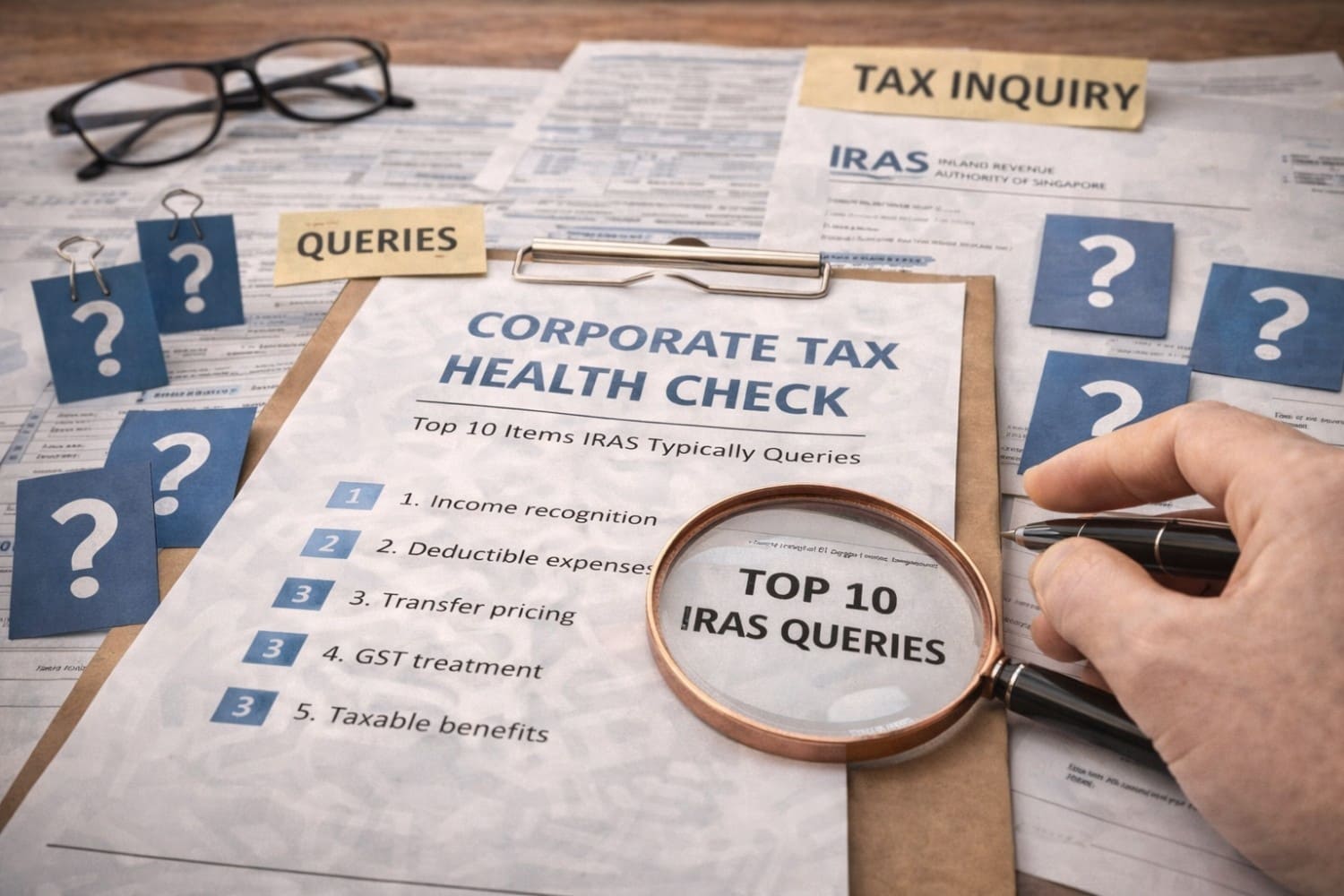
Figure 1: Proactive Tax Management
Most Singapore companies do not undergo a full IRAS audit every year, but many will, at some point, receive queries, letters or requests for clarification on their corporate tax filings.
In our experience, IRAS tends to focus on areas where:
- judgement is involved,
- incentives or claims reduce tax payable, or
- there is a higher risk of error or abuse.
This article sets out 10 areas companies should review as part of a �tax health check� to be better prepared if IRAS raises queries.
Note: This is a general guide and does not replace professional tax advice or the latest IRAS guidance.
1. Revenue recognition and unusual income movements
Why IRAS may ask
- Significant increase or decrease in revenue compared to prior years.
- Large other income items (e.g. grants, write-backs, gains) with limited explanation.
- Mismatches between turnover in tax returns and figures reported in financial statements or GST returns (if applicable).
What to check
- Ensure turnover and income breakdowns in your tax computation tie to audited financial statements.
- Be ready to explain major movements (e.g. one-off projects, sale of assets, grants).
- If using percentage-of-completion or complex revenue models, keep clear documentation of the basis and calculations.
2. Deductibility of expenses � �wholly and exclusively� test
Why IRAS may ask
- Large claims in categories such as entertainment, travel, marketing, professional fees or �miscellaneous expenses�.
- Sudden increases in expense items without clear business reasons.
What to check
- Verify that expenses are incurred for the production of income and not personal or capital in nature.
- Maintain invoices, contracts and receipts for significant items.
- Where expenses include both business and private elements, use reasonable allocation and document the basis.
- Be cautious with vague descriptions like �general expenses� or large round-sum provisions.
3. Related party payments and transfer pricing
Why IRAS may ask
- Significant management fees, service fees, royalties, interest or charges to related parties, especially cross-border.
- Large payments to related companies in low-tax jurisdictions.
What to check
- Ensure related party charges are supported by:
- agreements or engagement letters;
- basis of calculation (e.g. cost-plus, fixed fee); and
- evidence that services were actually rendered.
- For material cross-border transactions, consider whether transfer pricing documentation is required or advisable.
- Check that charges are consistent with commercial practice and not duplicated.
4. Director and shareholder-related expenses
Why IRAS may ask
- High director remuneration, bonuses or fees, especially in loss-making years.
- Significant director�s current account movements or loans to/from directors.
- Expenses which may have a personal element (e.g. vehicle, travel, club memberships, housing).
What to check
- Ensure director remuneration is authorised (e.g. board/AGM approval) and properly recorded.
- Distinguish between employment-related expenses, benefits-in-kind and shareholder distributions.
- Keep clear schedules of director�s current account movements and supporting documents.
- Consider potential taxable benefits at the individual level where relevant.
5. Claims for capital allowances and asset disposals
Why IRAS may ask
- Large claims for capital allowances (CA) on plant and equipment or renovations.
- Significant balancing allowances or charges due to asset disposals or write-offs.
What to check
- Maintain an up-to-date fixed asset register showing cost, additions, disposals and tax WDV.
- Ensure CA is claimed only on qualifying assets used for the business.
- Document the basis for write-offs or scrapping of assets and any proceeds received.
- Align CA claims with IRAS guidelines for specific assets (e.g. renovations, motor vehicles).
6. Loss carry-forward and group relief
Why IRAS may ask
- Significant unutilised tax losses or capital allowances carried forward.
- Frequent use of group relief or sudden large offsets against taxable income.
What to check
- Confirm that conditions such as shareholding continuity and same trade tests are met for loss carry-forwards.
- Keep records of ownership changes, restructuring and business model changes.
- For group relief, ensure election forms, computations and supporting documentation are complete and filed on time.
- Be prepared to explain large loss utilisation in a particular YA, especially if profits have returned strongly.
7. Tax treatment of provisions and accruals
Why IRAS may ask
- Large provisions in the accounts (e.g. warranties, legal claims, restructuring, bonuses).
- Significant differences between accounting profit and tax-adjusted profit due to provisions.
What to check
- Distinguish between provisions that are deductible (e.g. where there is a present obligation and reliable estimate) and those that are not deductible until incurred.
- Maintain schedules reconciling movements in provisions with amounts actually paid.
- Review long-outstanding provisions and consider whether they should be reversed or reclassified.
- Reflect appropriate add-backs or deductions in the tax computation in line with IRAS guidance.
8. Incentives, grants and special schemes
Why IRAS may ask
- Claims involving:
- special tax incentives or concessionary rates,
- productivity and innovation schemes,
- double deduction claims for R&D, training, or overseas marketing,
- capital grants or government support measures.
What to check
- Verify eligibility for any incentive or scheme claimed and retain approvals, letters or supporting calculations.
- Understand whether grants are taxable or non-taxable, and how they interact with deductions and capital allowances.
- Keep clear workings where enhanced deductions or special reliefs are claimed.
- Be ready to explain how the project or expenditure meets the scheme�s conditions, not just the accounting treatment.
9. GST vs income tax consistency (for GST-registered entities)
Why IRAS may ask
- Discrepancies between reported turnover in GST returns and income tax returns.
- Mismatches in timing or classification of key figures.
What to check
- Reconcile annual revenue per accounts with totals from GST returns, adjusting for exempt, zero-rated and out-of-scope supplies as needed.
- Ensure that any significant adjustments in the tax computation (e.g. unbilled revenue, deferred income) have a clear explanation.
- Where IRAS conducts a GST review, expect some cross-reference to corporate tax filings, and vice versa.
10. Non-resident payments and withholding tax
Why IRAS may ask
- Payments to non-resident persons (e.g. overseas service providers, licensors, lenders) where withholding tax (WHT) obligations may arise.
- Large or recurring cross-border charges with limited disclosure of WHT treatment.
What to check
- Identify payments that may be subject to WHT (e.g. interest, royalties, technical service fees, management fees in some cases).
- Review Double Tax Agreements (DTAs) to determine applicable WHT rates and conditions, if treaty relief is claimed.
- Ensure WHT, where applicable, is deducted and paid on time and that the corresponding filings are completed.
- Maintain agreements, invoices and WHT filings as part of your tax documentation.
Practical �health check� actions for directors and finance teams
To strengthen your tax position and be better prepared for IRAS queries:
- Review your latest tax computation alongside the financial statements and identify:
- large adjustments,
- areas involving judgement, and
- any new schemes or incentives claimed.
- Prepare or update documentation for:
- related party charges,
- major provisions and estimates,
- incentive and grant claims,
- director and shareholder-related transactions.
- Check consistency across:
- financial statements,
- ACRA filings (e.g. revenue in AR), and
- IRAS filings (ECI, Form C-S/C, GST returns).
- Discuss material or unusual items with your tax adviser early, rather than waiting for an IRAS query.
How Ascern can support a corporate tax health check
At Ascern, we assist companies to:
- perform tax health checks focused on common IRAS query areas,
- review tax computations and supporting documentation,
- identify potential risk areas and documentation gaps, and
- prepare practical action plans to strengthen tax positions before queries arise.
Our objective is to help businesses be proactive rather than reactive in managing their corporate tax risk.
If you would like to review your company�s tax position or prepare for potential IRAS queries, we would be pleased to discuss how we can assist.
Elevate Your Boardroom Dynamic
Discover how our strategic governance solutions can transform your organization's leadership and decision-making processes.